
What is a Mimosa Flower? Its Meaning and Story
Mimosa, one of nature's elegant and captivating flowers, stands out with its beauty and meaning. Particularly associated with International Women's Day, this flower is considered a symbol of freedom, resilience, and sensitivity. So, what exactly is a mimosa? What meanings does it hold, and where does it grow? In this article, we will examine the story and characteristics of the mimosa flower in detail.
What is Mimosa? What does it mean?
Mimosa, scientifically known as Acacia dealbata, is a species of plant belonging to the legume family (Fabaceae). It is also commonly known as "silver acacia" and is recognized for its bright yellow, tiny, ball-shaped flowers.
Despite its elegant and delicate structure, the mimosa flower is a hardy plant. It is most commonly grown in regions with a Mediterranean climate worldwide and quickly develops into a magnificent tree.
Although the botanical name "Mimosa" is sometimes confused with the sensitive mimosa (Mimosa pudica), they are different plants. Acacia dealbata, the plant we know as the "mimosa flower," is a larger tree-like form, while Mimosa pudica is a delicate plant that closes its leaves when touched.
The Meaning and Story of the Mimosa Flower
The mimosa flower has held various meanings in different cultures throughout history. Some of these meanings are as follows:
- Durability: Growing quickly and able to withstand harsh weather conditions, mimosa is a symbol of strength and resilience.
- Femininity and Elegance: With its elegant and delicate appearance, the mimosa represents a woman's aesthetics and strength.
- Independence: Particularly associated with International Women's Day, it emphasizes women's freedom and social roles.
The Story of the Mimosa Flower on Women's Day
The association of mimosa with International Women's Day on March 8th began in Italy in 1946. Following World War II, the Italian women's movement designated the mimosa flower as a symbol of Women's Day because it is both resilient to harsh conditions and beautiful. This tradition continues in Italy today, with mimosa flowers being given as gifts to women on Women's Day.
| |
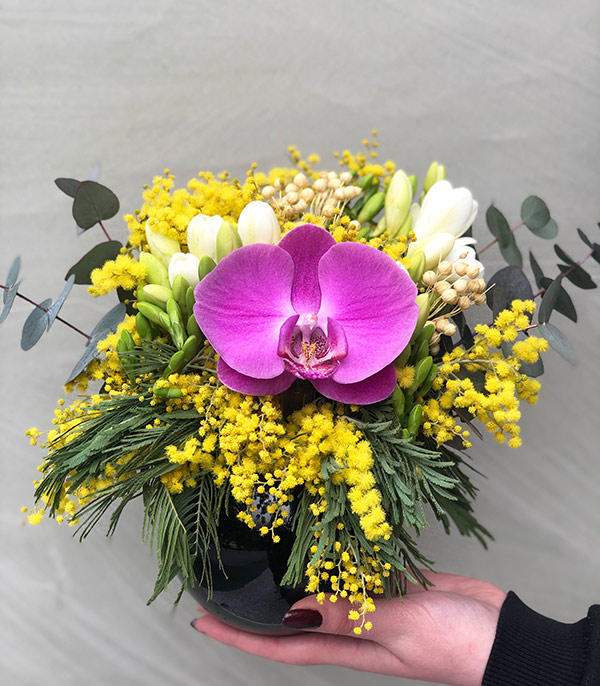



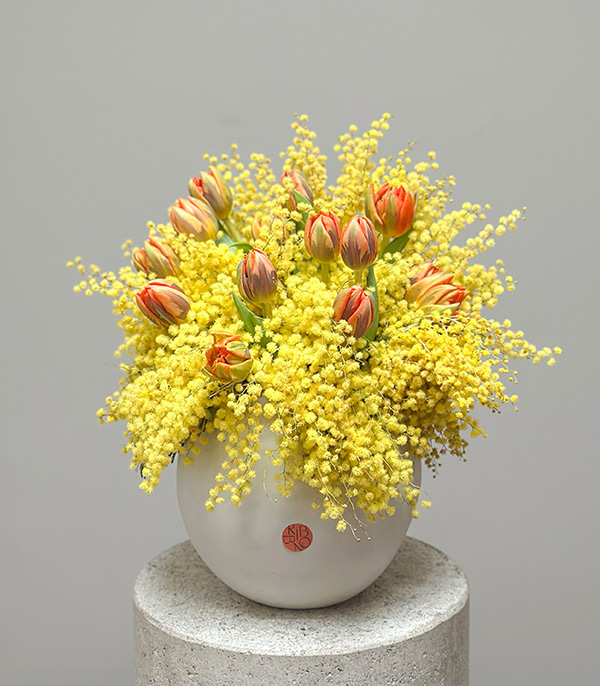
Tulip and Mimosa Arrangement in a Vase | |

Characteristics of the Mimosa Tree
- Structure: It is a fast-growing tree, often reaching heights of 10-15 meters.
- Leaves: They are silvery green in color and have a thin and delicate structure.
- Flowers: They are yellow, in small clusters, and fragrant.
- Fruit: It has brown, bean-like seed pods.
- Hardiness: It is partially resistant to cold weather and generally prefers warm and temperate climates.
Where does the mimosa flower grow?
Mimosa trees commonly grow in regions with a Mediterranean climate. Here are some of the main regions where they grow:
- Italy, France, and Spain: In Europe, it is most commonly found in these countries.
- Türkiye: Frequently found in the Aegean and Mediterranean regions.
- Australia: Considered the homeland of the mimosa.
- South America and Africa: It can also grow in tropical regions.
When do mimosas bloom?
Mimosa flowers bloom in late winter and early spring. They are usually in full bloom between January and March. In warmer climates, however, they can start blooming from December onwards.
In what climate does the mimosa tree grow?
Mimosa prefers warm and temperate climates. It grows best in the Mediterranean climate. While it is somewhat frost-resistant, it can be damaged by extremely cold weather. As it is a sun-loving plant, it is recommended to grow it in areas that receive plenty of sunshine.
Paylaş: